

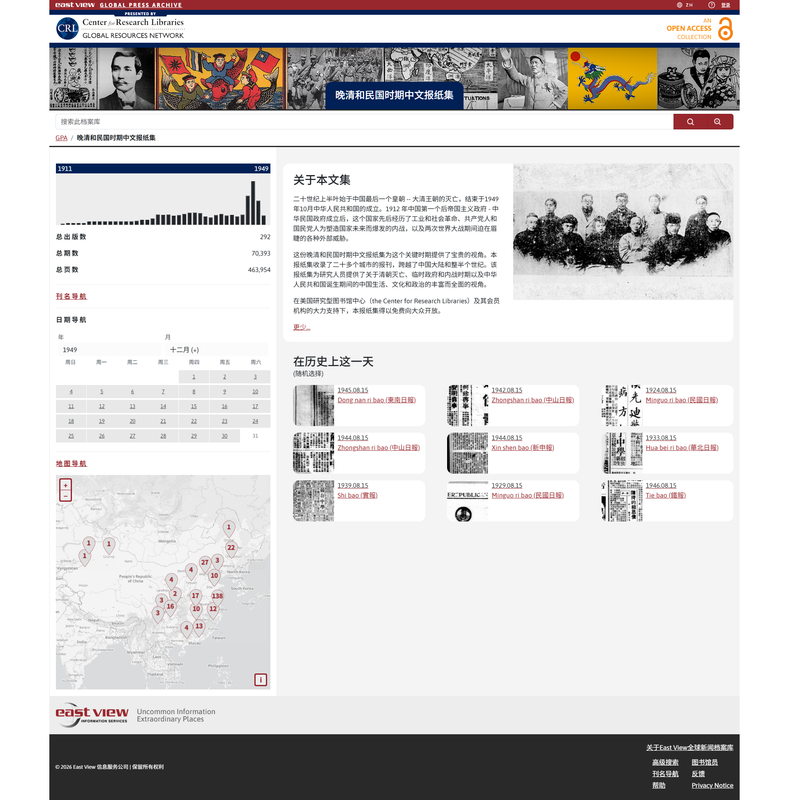


晚清和民国时期中文报纸集在美国研究型图书馆中心(the Center for Research Libraries)及其会员机构的大力支持下建成,由East View公司将该平台上的Global Press Archive (GPA)数据库中292种晚清和民国时期的报纸集免费开放。本报纸集收录了二十多个城市的报刊,为研究清朝灭亡、临时政府和内战时期以及中华人民共和国诞生期间的中国生活、文化和政治等提供了丰富的视角。
该数据库收录报纸292种,共计7万余期,总页数达46万页。其收录的报纸包括《时事新报》(1911.05.18-1948.12.04)、《实报》(1914.3.8;1928.10.23-1944.4.30)、《民国日报上海版》(1916.1.22-1932.1.25;1945.10.6-1947.1.31)等,可补充《小报》《新闻报》《申报》《大公报》等报纸资料库的不足。
该数据库基于OCR的全文检索功能,让使用者得以检索报纸内文,且支持中英文。检索结果中也会列出检索词所在的页面,并用萤光蓝色标示位置,方便读者确认。点选右上角的login并申请帐号,即可启用下载(整版下载/圈选区域下载/圈选区域复制文字)、列印等功能。
Global Press Archive
Supporting Area Studies and Advancing Digital Humanities

The Area Studies Initiative is the Global Press Archive program’s newest collaborative engagement with academic libraries to support the production of a diverse range of global newspaper archives.
Learn more
East View Global Press Archive® (GPA) is a program that embraces an unprecedented variety of global news publications, presented in full-image and full-text format optimized for scholarly use. GPA encompasses newspapers in more than 30 languages and will ultimately include titles from over 80 countries. GPA is the result of a landmark initiative of Stanford Libraries and the Hoover Institution Library & Archives to digitally preserve and make more accessible thousands of original print newspaper publications collected by the Hoover Institution and now housed by Stanford Libraries.
GPA includes both stand-alone titles and databases aggregating multiple titles from a specific region and time period. Wherever possible, titles are presented in their complete runs from the first issue. Many titles appearing in GPA will be first-ever digital versions of these publications and collectively this activity presents immense new value for scholarly research. Most GPA publications will be released on East View’s customized platform, while some titles will be made available through partners on their respective platforms, and new releases are continually being added to the program.
In creating GPA, East View is committed to ensuring that these valuable resources are preserved for future generations of scholars, and providing a maximally comprehensive and geographically diverse portfolio of resources.
