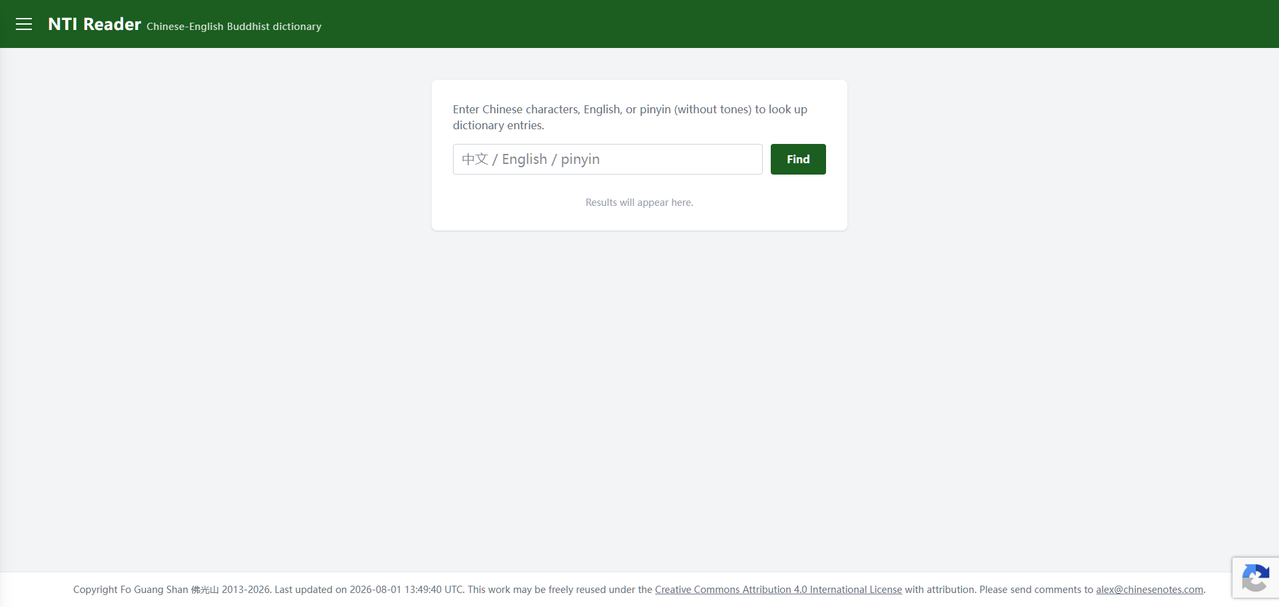
Chinese-English Buddhist dictionary
About the NTI Reader
The Nan Tien Institute (NTI) Buddhist Text Reader (NTI Reader) is a free, open source project for use in reading and analyzing Chinese Buddhist texts. For more a more detailed description of the NTI Reader, see the page Description of the NTI Reader. To find out what has changed recently, see the page What’s New or subscribe to the group ntireader-announce , a low volume group for announcements.
Goals
The goals the project are
- Create an online dictionary that is easy to use for everybody interested in Buddhism, including lay people reading Buddhist texts, students, translators, and academics. If you are looking at a large chunk of Chinese Buddhist text but not sure what it means then this is for you. See notes on the Casual use for a private translation workflow on ways that you can use the web site for this purpose.
- Create electronic tools that are useful for lingustic analysis of Buddhist texts, including identification of specialist Buddhist terms and comparison of Chinese and Sanskrit texts. If your goal is to translate the Mahāyāna Tripiṭaka, then this website and GitHub project is especially for you. See the workflow described in the section Project team member for a publicly available translation.
- Share the source code and content with the general public. If you want to reuse source code or contribute source code or data then the GitHub project is built for you.
Resources for Using this Website
- Frequently Asked Questions
- About the Chinese Buddhist Canon
- List of References for the NTI Reader Dictionary
- Translation of Chinese Buddhist Texts with the NTI Reader
- Understanding Buddhist Sanskrit Terms
More about Development of this Project
- Dictionary Style Guide for Buddhist Terms
- Description of the NTI Reader
- Introduction to Corpus Analysis of the Chinese Buddhist Canon
- Development of the NTI Reader Dictionary
- Metadata Used in the NTI Reader
